THE LONGEST RAILWAY FREIGHT ROUTE IN THE WORLD

The first direct freight train service from China to the UK arrived in London on January 18 of 2017. The journey took 7,456-miles and 18 days to complete. The new train is considered the modern-day Silk Road. This new route has made London the 15th European city to have a railway route connection with China.Rail
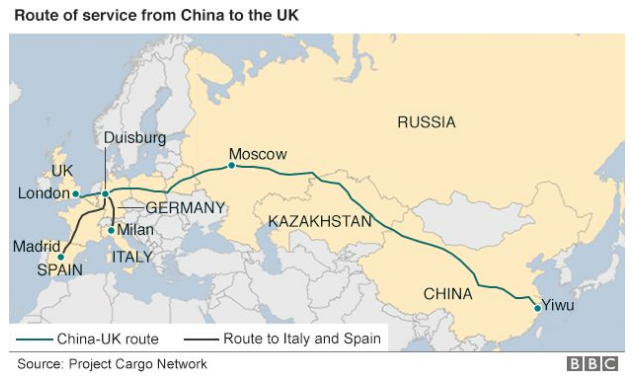
Nine countries are connected during this route: China, Kazakhstan, Russia, Belarus, Poland, Germany, Belgium, France, and United Kingdom.  The journey is longer than Russia’s famous Trans-Siberian railway, but shorter than the China-Madrid link. With cheaper services in comparison to air transportation and quicker delivery than ocean transportation, the new train railway successfully brings a new opportunity for growth.

China has become one of the world’s biggest exporters amounting to over $2.28 trillion in 2015. With President’s Xi vision to a brighter future for China and the world, he’s work is just beginning. There are already plans for another 20 European rail freight routes which will increase their export potential even more.

Written by Iris Arden (Ramon Inc.)

Sources:

http://www.thehindu.com/news/international/first-direct-london-china-train-completes-12000-km-run-in-20-days/article18299736.ecehttp://money.cnn.com/2017/01/18/news/economy/china-uk-freight-train-yiwu-london/index.htmlhttp://www.independent.co.uk/news/uk/home-news/first-direct-train-china-to-uk-arrives-east-london-yiwu-city-barking-channel-tunnel-a7533726.htmlhttp://www.bbc.com/news/business-38654176

Food Runs the World

Food provides almost one in three of the world’s population with a livelihood.  From restaurants, supermarkets, entertainment, food runs the world.

0ed6f43f6f27e75e3a92e0443cf18312--grilled-avocado-avocado-mozzarellaAgriculture, food, and related industries contributed $992 billion to the U.S. gross domestic product in 2015. In 2016, 21.4 million full and part-time jobs were related to agricultural and food sectors composing 11% of the total U.S. employment. While employment in agriculture and food-related industries supported another 18.7 million jobs. Food service locations accounted for the largest share with 12.2 million jobs with food/beverage stores supporting 3.2 million jobs. And the remaining agricultural-related industries together added another 3.3 million jobs. In 2017, the Bureau of Labor Statistics, which refers to restaurants as food services and drinking places, informed that sit-down restaurants compose 50% of the jobs; while, fast food restaurants composes 37%.

In 2016, America exported $24 billion in soybeans, $17 billion in meat and poultry, and $11 billion in corn.  And in imports, it was $130 billion with food variations from fish and shellfish to tea. With the high volumes of exports and imports, the demand for refrigerated containers and trucks has increased. According to the Maritime Research, Consulting and Financial Advisory Services (Drewry), the demand for refrigerated transportation will increase by 17% within 3 years.

And as the demand of food increases, so does the risk of food scarcity. With climate change affecting crops and studies predicting by the year 2050 deaths due to starvation, new strategies to maintain the world’s current population with enough good supply has become a challenge.

Although America has not faced agricultural hardships, other countries have. For example, Japan has included buckwheat alongside rice as part of their food culture; which means eating soba noodles has now become a part of being Japanese. France, India and Italy have included lentils and beans alongside wheat.

Food is at the center of almost every culture, a big part of the world’s economy, and a necessity to live.

Written by Iris Arden (Ramon Inc.)

Sources: https://www.ers.usda.gov/data-products/ag-and-food-statistics-charting-the-essentials/ag-and-food-sectors-and-the-economy/

http://www.bbc.com/news/av/business-39998549/value-of-global-trade-in-food-growing-strongly

https://www.theatlantic.com/business/archive/2017/08/restaurant-jobs-boom/536244/

https://www.thebalance.com/u-s-imports-and-exports-components-and-statistics-3306270

https://www.washingtonpost.com/news/energy-environment/wp/2016/03/02/food-scarcity-caused-by-climate-change-could-cause-500000-deaths-by-2050-study-suggests/?utm_term=.d730fde0e3ae

https://ideas.ted.com/what-americans-can-learn-from-other-food-cultures/

Where are the Truckers?

Truckers are a key part of freight transportation. 70% of all cargo is transported throughout the US highways. According to CBS News, the freight world needs to hire about 90,000 truckers a year to keep up with demand. And if truckers drive America’s economy, this is an alarming concern.

“A Shortage of Trucks is Forcing Companies to Cut Shipments or Pay Up” by Jennifer Smith from the The Wall Street Journal, really emphasized the growth in cargo freight in 2018. Not only did December of 2017 hit record levels in freight volumes, but 2018 has started out with a bang. The amount of freight needed to be transported is way more than the number of truckers available to transport it.

For example, in the spot market, about 10 loads were waiting to be moved in comparison to the previous year that had only 3 loads that were waiting to be transported. Truckers with the weather conditions have raised their price; depending on the company’s location and pick up wait time, the available truckers will turn down the job. The weather conditions have imposed great difficulty with the trucker’s transit, and companies in Canada are willing to pay double for truckers that are willing to make the trip.

smithfamily

Keep in mind that this is the slow season, so imagine when the freight market picks up in April. To keep with demand, companies are increasing truckers’ salaries and benefits. The lifestyle of a trucker isn’t an easy one, but companies are investing hard to attract more and more drivers. With a median salary of $41,000, many people are turning to trucking to live a better lifestyle, but hiring agencies still need to work hard to convince thousands more to join in. But even with all these actions, statistics still show that demand will outreach the drivers.

Written by Iris Arden (Ramon Inc.)

The Age of Google

In the age of the internet there are so many options available for just about anything. As consumers, it is imperative that we do our due diligence and research before making any purchases. For example, you may do research on the company’s history, read product reviews, or ask a friend for a recommendation.

world-of-internetWhen it comes to cargo insurance, the same is true. Many cargo insurance companies advertise on Google; however, Google is not a regulatory body. They are not responsible for whether a company is conducting unlicensed activity or not. More than just seeing a nice ad or a beautifully designed website, it is in your best interest to look past the surface. Here are three questions you can ask to help you identify a quality cargo insurance provider.

  1. Longevity – Do they have proven success and longevity in the industry?

Ramon Inc has been in business since 1982. We insure billions of dollars of cargo each year and work with the world’s highest rated insurance carriers. Our effectiveness in the industry has been proven and stands the test of time.

  1. Customer Service – Are they responsive to your needs?

Ramon Inc is centered around customer satisfaction and making our clients lives easier. With so much to do while running your business, you don’t need another hassle. Our company pioneered the technology that allows clients to issue their certificates online, anytime, anywhere. Additionally, our clients are consistently impressed with our quick turnaround time for any requests.

  1. Licensed – Are they licensed to sell insurance?

Ramon Inc. is licensed every state which includes major states: NY, CA, FL, GA, OH, NJ, MO, MI, NV, MA, PA, CO, TN, IN and other states. It is illegal for any company to sell you a certificate of insurance if they are not licensed. Insuring your cargo with a company who is not licensed is a substantial risk because in the even of claim, you will not be protected under any laws.

The staff at Ramon Inc are experts in the cargo industry. Contact us today and we would be happy to advise you further.

Written by Iris Arden (Ramon Inc.)

Mother Nature Wrecking Havoc on Freight & Trucking

Extreme freezing weather has caused chaos in recent weeks across the United States. The Midwest and the Southeast has faced the worst impact of winter storm Inga and many shipments have been delayed or destroyed as a result.

Hundreds of roads in the affected areas have been declared too hazardous to drive on, leaving drivers to seek alternate routes. For those who have dared to brave the highways, they have seen closed ramps and major accidents caused by the slick, icy roads. In Columbus, Indiana one lane had to be shut down after a trailer attached to a truck flipped over a concrete barrier. This is just one example of the level of destruction that winteingar weather can cause.

According to Freight Waves, weather contributes to up to $3.5 Billion losses in the freight industry each year. Also, more than 50% of all weather-related traffic delays are specifically due to snow and ice. This time of year can be very challenging for businesses as they are at the mercy of Mother Nature.

With so many unpredictable scenarios that can occur while your valuable goods are in transit, cargo insurance should be at the top of your priorities. Be proactive and prepared by purchasing cargo insurance before your next shipment.

Written by Iris Arden (Ramon Inc.)